
The Neuroscience of Intention: How Mindful Intention Changes the Brain, Harmonizes the Body, and Shapes the Life We Live
There is something profoundly powerful about pausing long enough to ask ourselves:
How do I want to live this season of my life? This day of my life?
Not just what do I need to get done…Not just what goals do I need to achieve…But rather:
What energy do I want to embody? What do I want to cultivate within myself?How do I want to feel while I am living my life?
This is the deeper work of intention.
And fascinatingly, neuroscience now confirms what contemplative traditions, mindfulness practices, and ancient healing systems have known for centuries:
Intentions literally shape our brains, influence our nervous systems, and affect the way energy moves through our bodies.
Intention Is More Than Positive Thinking
An intention is not merely a wish or affirmation.
An intention is a conscious orientation of attention, emotion, and behavior toward a desired way of being.
When we set an intention, we activate several important systems in the brain:
The Prefrontal Cortex (clarity, focus, decision-making)
The Reticular Activating System (RAS) (attention filtering)
The Limbic System (emotion and motivation)
The Autonomic Nervous System (stress regulation and safety)
In other words: setting an intention helps the brain decide what matters.
Neuroscientist Dr. Andrew Huberman often speaks about the brain’s ability to change through focused attention and emotionally meaningful repetition. What we repeatedly focus on quite literally strengthens neural pathways through neuroplasticity.
This means that intention is not abstract. It is biological.
Your Brain Begins Looking for What You Intend
One of the most fascinating systems involved in intention-setting is the Reticular Activating System (RAS), a network in the brainstem that acts like a filter for attention.
Every second, your brain receives millions of pieces of sensory information. The RAS helps determine what gets prioritized.
Have you ever:
Bought a new car and suddenly saw that car everywhere?
Set an intention to be calmer and suddenly noticed how reactive you normally are?
Decided to prioritize joy and began noticing small moments of beauty you previously overlooked?
That is the RAS at work. When you set a clear intention, your brain starts scanning for opportunities, patterns, resources, and behaviors aligned with it.
In essence: your intention becomes an internal compass.
The Body Responds to Intention Too
Intentions are not only cognitive. They are physiological.
Research in psychoneuroimmunology and mind-body medicine shows that our thoughts, emotional states, and perceived sense of meaning influence:
cortisol levels
immune functioning
heart rate variability
inflammation
vagal tone
stress resilience
When intentions are rooted in grounded emotional states such as gratitude, compassion, courage, connection, or purpose, the nervous system often shifts toward greater regulation and coherence.
The heart and brain begin communicating differently when we are aligned internally.
This is one reason intentions that are emotionally embodied are far more powerful than intentions that are merely intellectual.
Why Some Intentions Stick — and Others Fade
Many people set intentions or goals that never truly take root because they are created only at the level of thought.
But sustainable change happens when the brain, body, emotions, and behaviors are all engaged together. (See our Tree Angel Framework!)
Research suggests intentions are more likely to become reality when they include: emotional meaning, specificity, repetition, embodiment. Here are some useful tips when thinking about these four.
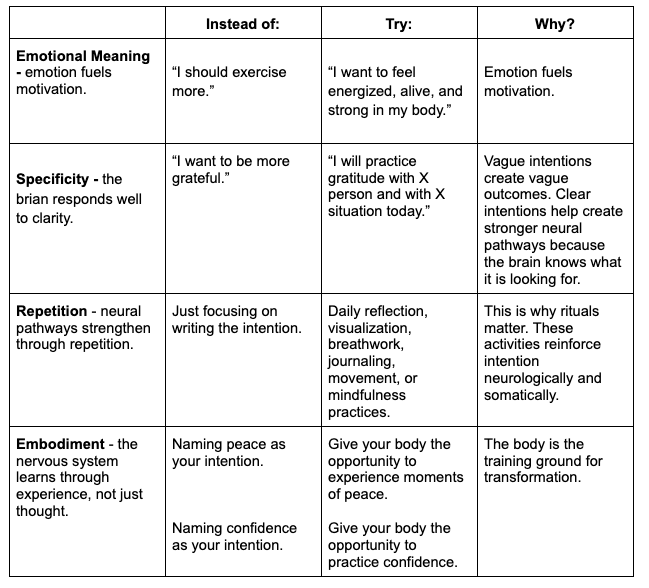
Intention and the Harmonization of the Body
When our thoughts, emotions, behaviors, and values are fragmented, the nervous system often experiences stress, internal conflict, and depletion.
But intention can create coherence. In neuroscience, coherence refers to different systems working in synchronized and organized ways.
When our internal world becomes more coherent:
breathing regulates
heart rhythms stabilize
stress responses soften
mental clarity improves
emotional resilience increases
This harmonization is not just psychological. It is deeply physical and energetic.
Intention as a Way of Living
Intention-setting is not merely about achieving more, it is about becoming more awake to how we are living.
More present. More aligned. More embodied. More connected to ourselves and one another.
In a world that constantly pulls us outward, intention gently calls us back inward.
Back to what matters. Back to what nourishes. Back to the wisdom already within the body.
And maybe that is where true “flow and glow” begins.
Not from striving harder…but from living more consciously, courageously, and coherently.
As I prepare for our upcoming women’s mini-retreat in Minneapolis Summer Flow & Glow, I find myself reflecting on this beautiful intersection between neuroscience, mindful awareness, embodiment, and energetic wellbeing, and how our work aligns beautifully to the embodiment of intention setting.
Come join us for a retreat focused on intentional living on Friday, June 26th from 2:30-5:30pm at the Yoga Sanctuary in Minneapolis, or winter 2027 in Belize! (Information coming soon.)